Is Microcement Worth It? A Designer's View
Microcement is everywhere on the Costa del Sol right now. No joints, no grout lines, and it goes straight over your existing tiles. Here's a designer's honest answer on when it's worth it and when it isn't.
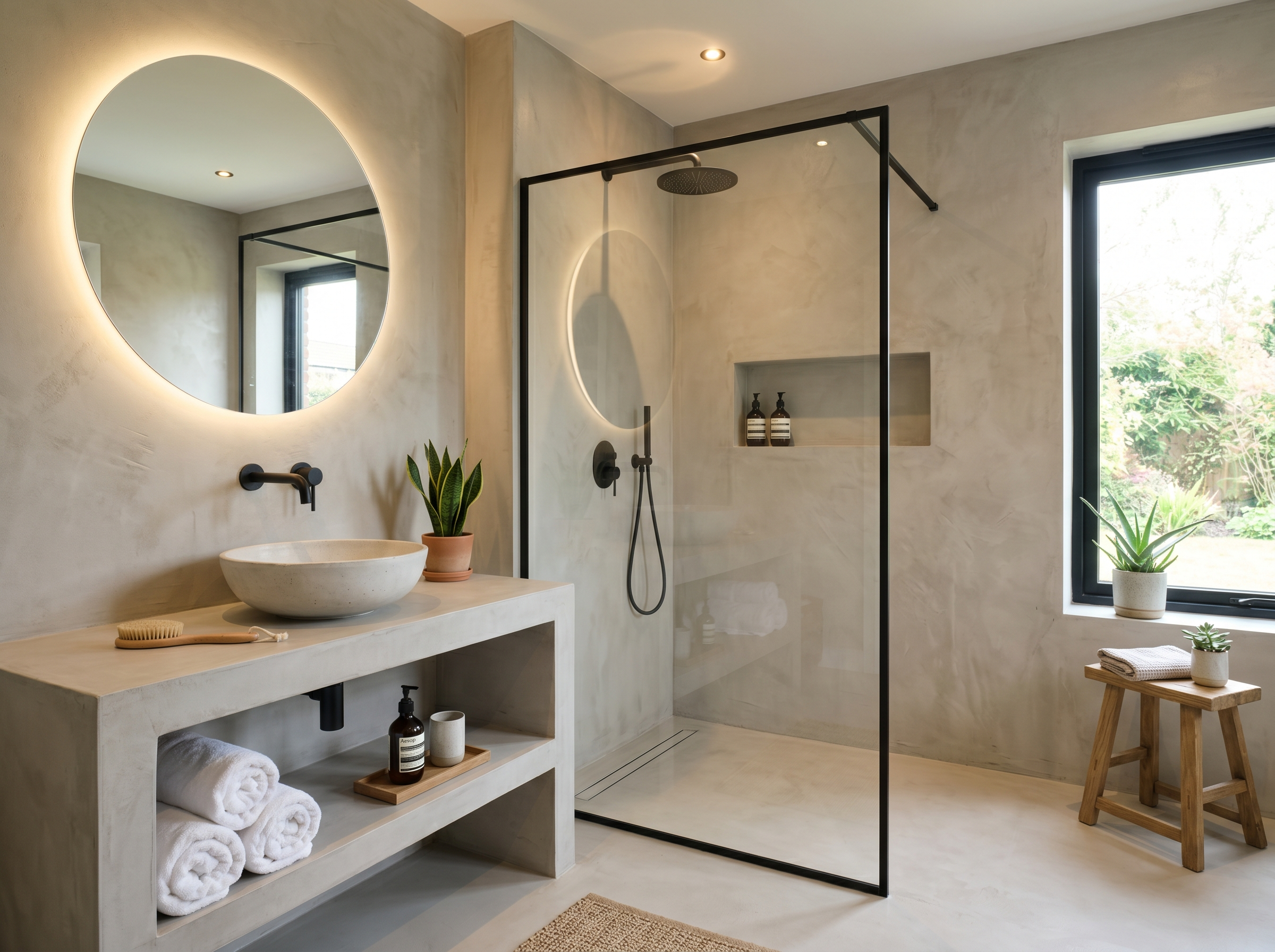
If you're renovating a property on the Costa del Sol, microcement is almost certainly on your radar. Walk into any newly renovated bathroom in Málaga, Marbella or Estepona and you'll find it: that continuous, jointless surface on the walls and floor, slightly textural, slightly raw, unmistakably contemporary.
It's been the dominant finish in renovation projects here for the better part of a decade, and it shows no sign of disappearing. But as with anything that becomes a default, it's worth slowing down and asking the right questions before your contractor adds it to the quote. When does it actually work? When does it fail? And is paying a premium for it worth it on the Costa del Sol?
I've used it across several projects and I've also talked clients out of it when the brief didn't call for it. This is what I know.
What microcement actually is
Before anything else, a quick clarification, because the term gets used loosely. Microcement is a thin continuous coating, typically 2-3mm thick, made from a blend of cement, resins, polymers and mineral pigments. It's applied directly over an existing surface, including tiles, concrete, plasterboard and even some wood substrates, with a trowel, in multiple layers, then sealed.
That last part matters. The seal is what determines how the finished surface actually performs. A poor seal on a bathroom floor is where most of the horror stories come from.
Key qualities
- —No joints, no grout lines
- —Very thin (2-3mm) — doesn't raise floor levels significantly
- —Can be applied over existing tiles — no demolition needed
- —Wide colour palette, various texture finishes
- —Quality of the seal determines everything
Where microcement works well on the Costa del Sol
Bathrooms and wet rooms
This is where microcement earns its reputation. A properly applied and sealed wet room is genuinely beautiful and, if done correctly, watertight and easy to maintain. The absence of grout lines means no mould accumulation, which is a real issue in a coastal climate where humidity is higher than in Northern Europe.
Floors in open-plan spaces
A continuous floor that runs from kitchen through living area and out to a terrace creates a visual flow that tiled floors simply can't replicate. It reads as calm and spacious, particularly useful in properties that aren't large. In a recent project, a client wanted a Mediterranean minimalist feel with the interior and exterior reading as one continuous space. Microcement on the floor, running through to a terrace with the appropriate outdoor-grade product, was exactly the right call.
Renovation without demolition
This is the practical argument that makes microcement so popular on the Costa del Sol. In a property where you want to renovate but can't face a full strip-out, microcement can go straight over existing tiles. No rubble, no skips, significantly less disruption and mess. For investment properties being prepared between lets, this is a major advantage.
Where microcement fails
Applied by someone who doesn't know what they're doing
This is the number one failure mode, and it accounts for almost every bad microcement story you'll hear. Microcement is an artisanal finish. It has to be applied in the right conditions (temperature, humidity), in the correct number of layers, with adequate drying time between coats, and sealed properly at the end. Cut any of those corners and you get cracking, uneven colour absorption, waterproofing failure, or a surface that scratches within a month. The material itself is not expensive. The labour is what you're paying for, and skimping on it is always a mistake.
Rooms with electric underfloor heating
Microcement and electric underfloor heating don't mix well. The repeated heating and cooling cycles cause the surface to crack over time. If your renovation includes underfloor heating, this is not your finish.
Small, complex surfaces where the economics break down
A single bathroom with lots of corners, niches, a custom shower tray and built-in elements can end up costing more than a full tile renovation using high-end tiles. The labour component is high and doesn't scale down for small jobs the way tile work does.
Over structural problems
Microcement applied over a surface with movement, damp ingress, or poor substrate adhesion will crack and fail. It amplifies underlying problems rather than hiding them.
On south-facing exterior terraces without the right product
Standard interior microcement does not belong on a sun-exposed terrace in Málaga. There are exterior-grade products designed for the climate, but they need to be specified correctly. Fading, cracking and waterproofing failure are common when the wrong grade is used outdoors.
Is microcement a fad?
It's been called a fad for at least six years and it hasn't faded. My read is that microcement is not going away, but it will become more selective.
The wet room aesthetic, seamless, muted and calm, isn't tied to a trend cycle the way furniture styles are. It suits the Mediterranean climate and the kind of properties buyers are looking for on the Costa del Sol: airy, low-maintenance, photographically strong for short-term rental listings.
What will date is the indiscriminate version of it. The whole apartment in microcement, every surface, kitchen-bathroom-bedroom-corridor, all in the same mid-grey. That specific look already feels tired in 2026. Used purposefully and combined with warm materials like wood, stone, woven textures and plaster walls, it has real longevity.
Think of it like white walls. White walls aren't going anywhere, but the specific way people used them in 2015 (everything white, white on white, nothing else) did date. Microcement is the same. The material is permanent; the overuse of it is not.
What does microcement cost on the Costa del Sol?
The honest answer is: it depends, and anyone who quotes you a number without seeing the job is guessing. That said, here are the real benchmarks for Spain in 2025-2026.
Cost overview (Spain, 2025-2026)
Material only (not installed)
Roughly €25-50/m² depending on brand and product type. See brands section below.
Installed (material plus labour, full system)
Typically €60-100/m² for standard surfaces. A standard bathroom (20-25m² total surface) runs €1,800-3,000 all-in for a professional job.
The red flag price
If someone quotes under €40/m² installed, ask hard questions. Cheap materials exist, and the difference shows within 12 months.
A quick note on why the process matters: application involves preparing the substrate, a bonding primer, fibreglass mesh reinforcement, two coats of base layer, two coats of colour coat, and at least two sealer coats. Each layer needs to dry correctly before the next goes on. Rush it and you're buying a redo within a year.
Microcement brands in Spain: entry, mid and premium
One important thing to say before this list: the brand matters less than the applicator. The best products applied badly will fail. A skilled applicator using a mid-range product will outperform a novice using the premium one every time. Ask to see completed work, ideally work that's a couple of years old, before you hire anyone.
Entry level
Decocement ships across Spain from Barcelona. Their system comes as a complete kit including base, colour coat and sealers, useful if you're sourcing material to pass to a local applicator. Good for straightforward projects where budget is a priority. decocemento.com
CimentArt has offices across Spain and has been supplying the market since 2009. Reliable and established, with a fully waterproof product line. A solid entry-to-mid option for standard residential work. grupocimentart.com
Mid range
Topciment is one of the most widely distributed professional brands in Spain, ISO certified. Their Sttandard system is popular for bathrooms and Microdeck for floors. Well-supported through applicators on the Costa del Sol. topciment.com
Topcret sits at a similar level. Their Baxab ECO product is water-based with no solvent fumes during application, worth considering if the property is occupied nearby. topcret.com
Premium
Lunik is at the top end of the market. Their resin and epoxy-based systems (Onerock and Onepox) technically outperform standard cement-based microcement on impermeability and scratch resistance. Worth it for high-use floors or wet rooms where you want maximum durability and don't mind paying for it. lunik.cc
For finding a local applicator on the Costa del Sol, ask your architect, interior designer or project manager for a referral rather than searching cold. The market has a lot of operators with very variable quality, and a recommendation from someone who has seen the finished work is worth considerably more than a Google review.
Renovating a property on the Costa del Sol and working out which finishes make sense for your brief and budget? Get in touch at gosia@thedreamspaces.com or fill in a 2-minute form to get a conversation going.

Gosia Szwed-Pruvot
Founder, The Dream Spaces
I am the founder of The Dream Spaces, an interior design studio in Málaga working with foreign buyers across the Costa del Sol. The studio specialises in design-led properties that perform commercially, from holiday lets to mid-term rentals to private homes.
Prices and supplier information correct as of May 2026. Always get multiple quotes and ask to see completed examples before committing to any applicator.